A Nomad City
Christ and Cosmopolis Part 11

Chat (Quintidi), 25 Nivôse, CCXXXIV
I: The Garden and the City
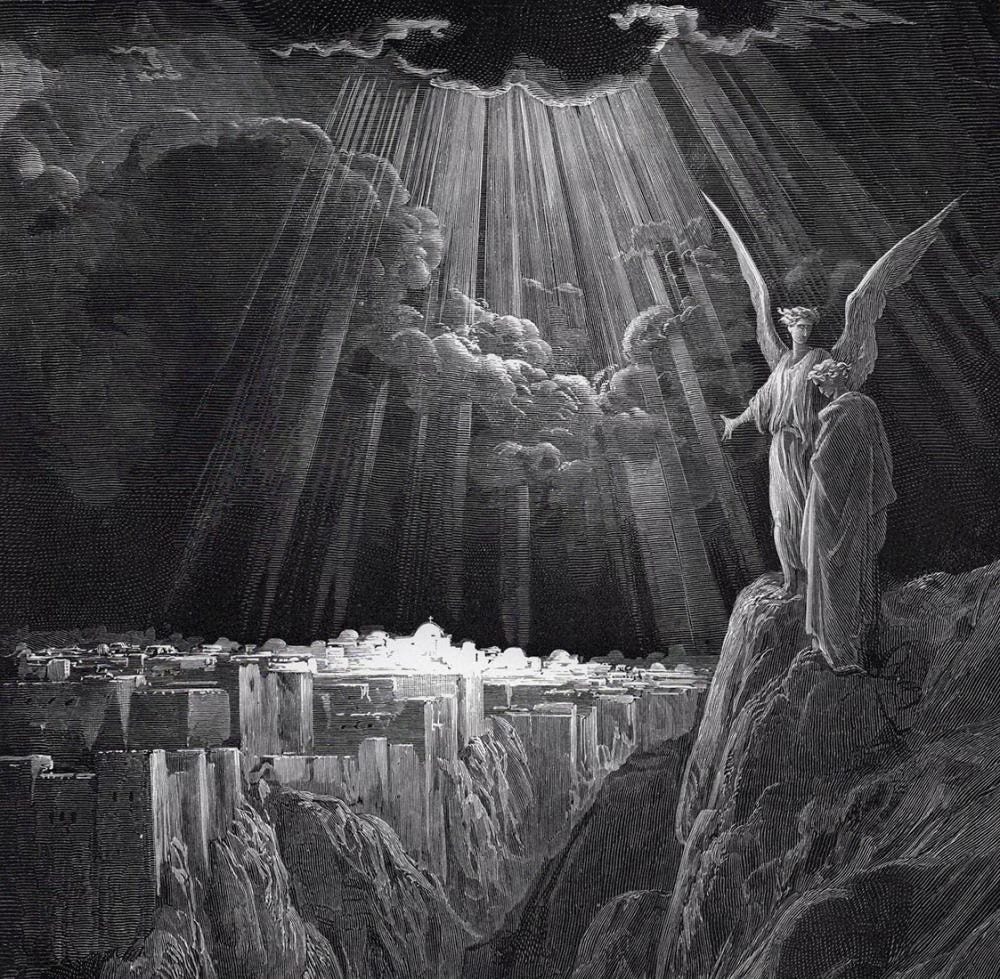
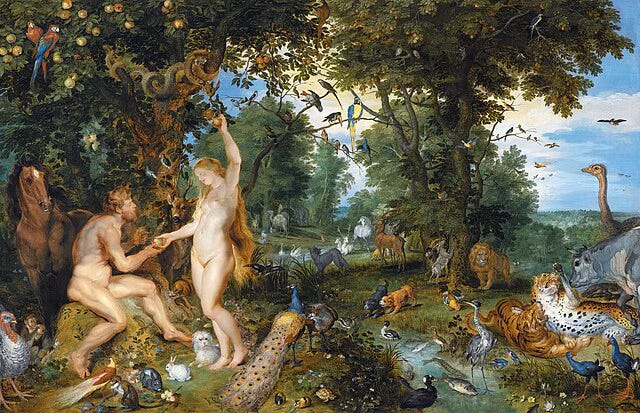
This series has taken a wandering course, sometimes crossing the same territory more than once, but somewhere back near its point of departure I talked about my pathetic longing for some terrestrial paradise that could somehow unite all the blessings of life in an unspoiled wilderness and of life in a thriving city. My temperamental preference would be for the former as a physical setting and the latter as a cultural experience, or for the former as a place and the latter as an atmosphere, or for the former as the home of my body and the latter as an adventure of my spirit (or something like that). Or, to put the matter in Biblical terms, I have a longing for a place that is at once Eden, the garden of our first innocence, and the New Jerusalem, the city of our final innocence (which has a garden at its center rather than a temple). One’s initial impulse, on first considering such a notion, would probably be to say that this is a dream only, impossible to translate into a concrete reality in this world. At a practical level, this may be so; but is this a truth of logic or simply of circumstances? I would say the latter. Surely the question is one of proportions and dimensions and freedom of movement. We live now according to a law of segregated topography that in one sense is simply the seemingly inevitable result of a very long human history of settlement, displacement, resettlement, colonization, agriculture, and urbanization; but it is also the result of a certain contingent story of settlement, displacement, resettlement, colonization, agriculture, and urbanization, as assumed into the ideological and social projects of the nation-state and the increasingly technocratic projects of modern commerce and capital. It is true, perhaps, that history is destiny, but true also that no history is irresistibly destined to unfold. It is only when we recognize this paradox, and find ourselves detained and provoked by it, that other possible histories—other possible pasts and other possible futures—take shape in our minds and in our hopes. After all, that ideal place that is at once both the earthly paradise and the heavenly city was at one time, in however shadowy and distorted a form, much more easily imaginable within the actual conditions of humanity’s shared reality than it is within the system of rigidly quarantined geographical, social, economic, and political spaces we now inhabit. Again, the question is one of the topography of human experience and desire: where we draw boundaries, how impermeable the walls we erect, how fiercely we guard the borders, how jealously we seek and sustain our familiar shelters, how we organize our economic infrastructures within space and time, and how we construct our social localities around that organization of material means and ends. How, that is, we imagine and define the spaces in which we live and in which we do not live, and with what sense of belonging or liberty we move between them. The terrestrial paradise of my imagining is not an impossibility, logically speaking; to realize it within history requires only the recognition that the place of our free and common dwelling can be no smaller than the ‘city of the world’: the cosmopolis.
Another theme in this series has been the genesis of the modern nation-state, first as an aspiration, then as a conscious ideology, then as a habit of thought and belief purged of any memory of other possibilities, but always and in every respect at the service of an emerging economics of capital, ceaseless production, and insatiable consumption. In political and social terms, but also in cultural and moral, this has been the chief victory of Western modernity over the past. It came in association with a certain number of genuine advances in civil and legal freedoms, but also in association with a certain number of ever more pervasive coercions and structures of exploitation. History is not either progressive or cyclic, and none of its stories comes with a single unambiguous moral at its end. It is, to borrow an image from Hegel, a Bacchantic frenzy, in which no dancer is not drunk. What, however, is certain about the triumph of international capital and nationalist polity is that it came not merely at the end of a certain history, but as an active war to reshape the past in human memory. In earlier installments in this series, I also discussed—far too synoptically—the deep past of human nomadic societies, the development of agrarian and in time urban societies, the expansion of the fused energies of both the peregrine and the settled into empires, the contraction of empires into spheres of absolute sovereignty, the crystallization and induration of kingdoms into nation-states, the ideological invention of ‘natural’ ethnic solidarities, the exploitation of sequestered resources (including ‘human resources’), and so on. Every step along the way may have been the inevitable result of all the steps already taken, and yet every one of them may also have been only an accident of those prior causes and in that sense essentially arbitrary. It is this latter truth that the prevailing ideologies of the modern world conspire to banish from human consciousness. It is always in the interests of the powers of the age to claim that there is no other option.