Confessions of an Irreligious Christian
Or, Christ plays in ten thousand places
Guède (Sextidi), 26 Pluviôse, CCXXXIII
Be patient with me, please. This is all likely to sound very peculiar, and I have long hesitated to say any of it for fear of creating misunderstandings; but I have been so often asked about the nature of my faith and my reasons for espousing belief in Christ that I thought it was about time I gave up being demure. This is not a comfortable undertaking; the confessional mode is not natural to me; but a few weeks back I agreed to give it a try after a number of readers here pressed me (politely) to do so. Before, however, saying why I believe, I first have to take account of all the more common motives for faith that seem to be utterly absent in me; I have no desire to scandalize anyone, though I just might, but I think I need to own up to certain of my own limitations. The best designation I seem able to come up with for describing my general spiritual sensibility is that of ‘irreligious Christian’, though I acknowledge that it is an obscure phrase. I do not mean something along the lines of Bonhoeffer’s ‘religionless Christianity’—nothing quite so admirable—as that was a moral call to living out one’s faith in all the concrete occasions of worldly life. Much less do I mean something like Gianni Vattimo’s Heideggerean reduction of the metaphysical inheritance of Christianity to a historical stream of ontological dispensations or a redemptive nihilism or a hermeneutical Überlieferung consequent upon the annunciation of God’s kenosis in Christ, which culminates in secularization and the irreversible weakening of all ‘strong structures of thought’. (I see a certain solvency in the historical analysis, but not so much in the ontology.) Least of all do I mean something like Slavoj Žižek’s Hegelian-Feuerbachian-Marxist-Heideggerean-Lacanian ‘Christian atheism’, which is a fairly obvious philosophical move but one better explored by way of Ernst Bloch (who lacked Žižek’s theatrical flair, but who had a more genuinely prophetic soul). I mean something altogether more mundane and maybe a little psychologically morbid: the faith of someone—myself, that is—who has little or no natural aptitude for religious sentiment, enthusiasm, devotion, or ritual observance. I do not mean to say that I am wanting in reverence or the ability to feel awe; I have all of that in sufficient quantity. I simply find that what excites those aspects of my character is rarely if ever found in a conventionally ‘religious’ context. I have come to accept that I am a thoroughly secular man who happens to believe that Jesus of Nazareth rose from the dead.
Of course, in my case in particular this is something of an amusing predicament, rather like the situation of a musicologist who happens to be tone-deaf. After all, I have been writing on religious topics for decades now, and one might reasonably suppose that I have done so because they occupy a central place among my special intellectual and spiritual concerns; I am even routinely described as a ‘theologian’, though I have never used that word about myself. But, as I have frequently noted (though with little success in convincing anyone), theology is not a form of writing in which I take very great pleasure, and I pour far more of myself into my fiction, literary essays, observations on the arts, cultural laments, studiously perverse obiter dicta, and disquisitions on baseball. And then, on the next tier down, my philosophical writing is of more importance to me than my contributions to debates on dogma, scripture, or systematics. Not that I do not take some satisfaction in having made a theological argument well, at least by my lights, but even my most sympathetic readers have as a rule noticed an occasional tendency toward the combative, the flippant, and the satirical even when I am dealing with matters of the utmost spiritual import, which is certainly a personal flaw to which I have all too often and too gleefully surrendered. Persons naturally suited to theology do not do that. The truth is that, for me, the task of writing on theology has been one of negotiating a small number of delicate conceptual difficulties, in the hope of better understanding two historical anomalies that I believe I perceive at the origins of Christianity.
I will get back to those, however. Before then, though, I should make as clear as I can what I mean when I speak of my ‘irreligious’ temperament, just for honesty’s sake. I mean that I have no sentimental attachment to religiousness as such, frequently wish I could do without it, and quite unreasonably often resent its intrusions into my life. As a set of practices, ritual or imaginative or votive, religion tends to bore me or leave me depressed. I can find some degree of rapture in religious settings, prompted by beautiful words, beautiful music, and beautiful architecture; the English of the King James Bible or Cranmer’s collects, the polyphony of Palestrina or Bortnyansky, flying buttresses and rose windows and the glowing vaults of Pantokratic domes—all of it—can captivate me; but it is a purely aesthetic rapture, unconnected to the devotional content of the art, and not conspicuously more fervent or profound than the rapture inspired in me by Robert Louis Stevenson or Thomas De Quincey, Chopin or Satie, Chardin or Velasquez, Palladio or Frank Lloyd Wright. Less so, truth be told. Actually, the absence of any felt burden of extraordinary reverence in these latter instances makes them all the more spiritually liberating for me. And my most sincere and spontaneous experiences of a sense of the transcendent have as a rule come about from encounters with nature and the arts rather than from anything remotely like formal worship. I suppose I am not a particularly exotic Christian specimen in disliking the homiletic portion of the liturgy, except in those rare instances when a truly interesting mind allied to genuine eloquence is accidentally installed in the pulpit; a great many parishioners, I expect, regard sermons as ordeals to be endured as part of the price of eternal life and perhaps of domestic harmony. But I go further: I find myself now barely able to abide most hymnody, litanies, the psalter, or even (I am ashamed to say) sacrament. The original eucharist, which was probably a sharing of bread and wine at a common meal where distinctions of class and nationality were ideally erased, and which was something more like a Sikh langar than like an Orphic mysterion, would likely appeal to me in ways that receiving the consecrated elements no longer has the power to do.
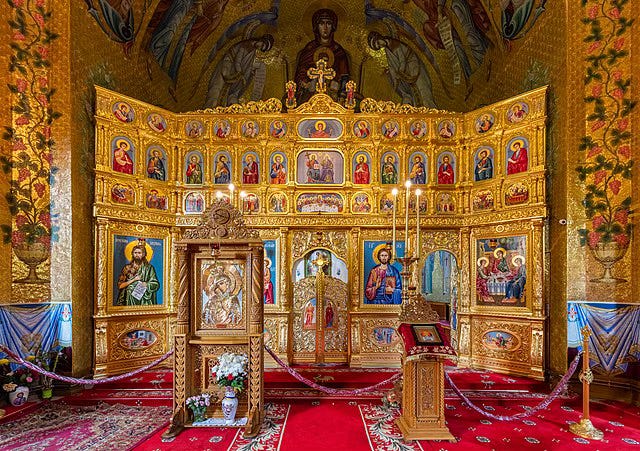
This is probably an especially absurd situation for someone who has been Eastern Orthodox for forty years. I cannot tell you how often I have been encouraged in conversation to profess my fervent love of Byzantine ritual, or how often an interlocutor has assumed that a large part of what drew me ad orientem was the splendor of Orthodox worship. At one time that was so; I was initially appropriately mesmerized by the spectacular, barbaric, heathen dramaturgy of the Divine Liturgy, with its exaltations and impetrations, its elaborate choreography of stately entrances and grand exits, its choral strophes and antistrophes, its iconostasis with three doors like the ancient Dionysian stage, and so forth; but the enchantment faded over time (rather as if I were going to the same ballet every weekend—even the most exquisite performance of Giselle can be watched with interest only so many times). Anyway, having come from a very high Anglo-Catholic milieu, I was already accustomed to impressive liturgies, even if they were conducted in a slightly more orderly and British fashion. I was drawn eastward by the Greek and Syrian fathers, and by the total absence of any element of the late Augustine’s theology in the Orthodox tradition, far more than by the clouds of incense, jangle of thuribles, sheen of satin, and ululations of chanters.
Moreover, I have come to realize over the years that my taste in art does not run toward the Byzantine; indeed, it tends to run pretty energetically in the opposite direction. Eastern Christian iconography can be quite striking and lovely, though I and my wife prefer Coptic icons—with their bold colors and winsomely doll-like little figures—to the Greek or Russian varieties. An artist of genuine gifts can make the inherited forms shine with a very special kind of beauty; I have a sister-in-law who has that ability. But, at its not infrequent worst, it is a style of sterile opulence, one that all too easily degenerates into the most appalling kind of kitsch. Most Byzantine icons, executed by artists of meager originality or vision, are really quite vulgar productions, what with those garish gold-leaf skies and those foregrounds populated by grotesquely twisted human figures with stern and misshapen faces, set off against nightmare landscapes. In its beginnings, the whole style represented a decline from the arts of earlier ages, often an almost cartoonish didactic visual idiom intended for simple believers, far inferior to the great achievements of Greek, Graeco-Roman, and Egyptian antiquity; and in later centuries it all too often represented only a condition of millennially arrested cultural development, one that Western Europe was fortunate to escape in the direction of Goya and Vermeer. If that sounds ungenerous, I am sorry; but, to be fair, it is also the result of having had to endure years of outlandish spiritual claims made by apologists of Eastern Christianity who think they must denigrate Michelangelo for the sins of originality and genius while making boorish attempts to consecrate centuries of cultural stagnation in the Byzantine world as evidence of mystical profundity. A single canvas of Titian far outshines almost the entirety of the Byzantine artistic achievement. The luminous silvery greens and blues of Turner’s rendering of Venice’s Grand Canal is a far more pellucid window into heaven than all but a very few icons, produced by iconographers who were able to transcend the limited pictorial genre to which they were confined. This is not to say I dislike all icons. Neither is it to say that I have no icon corner in my home, though that consists entirely in a single diptych of Passion Friday and Easter Sunday given me by Fr. Thomas Hopko (of blessed memory). Prints of Hokusai enjoy greater prominence in the aesthetics of the household, and typically evoke richer sentiments in me.
Nor can I claim a particularly vibrant personal spiritual life. I have two brothers who are capable of a rigorous schedule of prayers and readings, observing the daily offices and keeping to the lectionary, and both have encouraged me at times to imitate their example; but the habit will not take in me, and the attempt to cultivate it has invariably resulted in agonized boredom. I do pray, with a kind of constant inconstancy, but it has mostly the character of a continuous stream of inward addresses to and occasional arguments with a Father who seems little inclined to respond. That, I assume, will never change. Then, too, I seem to have no appetite for devotional or spiritual reading; Burton, Browne, and Montaigne, or Proust, Borges, and Nabokov, or Goethe, Dickens, and Kafka—these are sacred texts to me in ways that the writings of Symeon the New Theologian or John of the Cross have never been. I receive a far more powerful frisson of spiritual transport from Invitation to a Beheading and Riders in the Chariot than from any explicitly religious text of which I am aware (though I suppose that may be because I am guilty of ‘gnostical turpitude’). Throughout my life, I have committed reams of poetry to memory, but have never taken the trouble to memorize a single line of scripture (though obviously I have picked up quite a few from regular exposure). As Roland remarked in a certain book of mine, if I were moved to create a religion after my own heart, its central ritual observance would be the Japanese tea ceremony and all the readings would come from The Hunting of the Snark and The Wind in the Willows. As for saints, I often find them the more attractive the more legendary they happen to be, and those who are not I hesitate to ask for favors—except of course St Guinefort, who is very real indeed and to whom I have a special devotion. Well, come to think of it, I do send a petition or two upward to Origen now and then—St Origen, rather—but that is as much out of a desire to play the renegade as from any especially deep reserves of ‘Religiousness B’. And, when it comes to angels, I like them to be as non-apocalyptic as possible: Henry Adams’s serene angels of Mont-Saint-Michel, Walter Benjamin’s despairing angel of history, Wallace Stevens’s necessary angel of imagination, Rilke’s schreckliche angels of presence (with their stärkeres Dasein). The ones you meet in, say, the book of Revelation leave me curiously anxious.
I am not even sure what ‘spiritual’ claims I should make for my intellectual life. If mine is too much a Christianity of the mind, it is also a Christianity often stumbling over mental reservations or private speculations. Of course, Christianity comes in so many varieties that one can generally wriggle off the hook of any particular dogma or theological system without renouncing one’s faith; moving to Eastern Christianity long ago relieved me of the burden of pretending patience for such abysmal nonsense as the ideas of inherited guilt or penal substitutionary atonement or predestination ante praevisa merita; but even that did not allow me to escape vague but seemingly binding notions of God’s limited will to save or of an ultimate division between the blessed and the damned (which to me makes the blessed seem peculiarly damnable and the damned boundlessly pitiable). In any event, too long a study of scripture and early Christianity inevitably disabuses one of the illusion that later doctrinal history is quite the natural and ‘Spirit-breathed’ unfolding of the original kerygma that it frequently presents itself as being; and, once one realizes this, dogma as such, solely on its own authority, loses its power to command unqualified assent. It is for just this reason, after all, that many in the theological world nurture in their breasts a fierce resentment of historical-critical scriptural scholarship: not for its excesses of speculation or its lack of hermeneutical latitude so much as for its moments of annoying intellectual honesty and inconvenient rigor. For myself, though, the will to believe stops short of willful ignorance (or so I like to think).
I have never, moreover, been able to get very far past the problem of evil when it chooses to spring up in the road before me like the Lord in the path of Moses on the way back to Egypt; nothing the staretz Zosima says provides an adequate response to Vanya’s ‘rebellion’. I could allegorize the myth of Eden as the tale of preexistent spirits falling away from the vision of God into time, despite the conceptual difficulties such a notion produces; but this, when meant as a form of theodicy, seems to me every bit as morally unpalatable as the advice I once received from a Gelug Buddhist monk—to the effect that I should not give money to a beggar since the poor wretch was precisely where his own karma had placed him. I refuse to see a little girl dying of cancer as suffering the condign penalty for or pedagogical correction of some sin she supposedly committed outside time or memory. But, of course, any more literal notion of the fall as an intratemporal event is both absurd and no less morally atrocious as an explanation of that girl’s cancer. Rather, I simply take the Eden narrative as an unfathomable dream of something that we remember, even if it never happened to us—a story that apprises us that something has gone very wrong, but with only a dark fairytale logic.
And, finally, I can honestly say that my faith is not a matter of wishful thinking; it is not an expression of some pathetic adherence to ‘cultural Christianity’ or of some even more pathetic terror of nonexistence. As to the former, as much as I am a critic of and fugitive from most of late modernity, and sincerely believe that the way we live now is terrifically insane, I feel not the slightest desire to return to some wholly premodern social and religious order. I have known of many ‘culture warriors’ and ‘traditionalists’ who abominate every figure of the past who had the temerity to break free from the (largely mythical) consensus of Christendom, and who regard every philosophe or Aufklärer of the ‘Age of Reason’ as an agent of the devil. I by contrast find I have a deeper affection for Voltaire and Thomas Paine than for just about any of their religiously cultured despisers, and discern in them a more genuinely Christian spirit than I do in most of their more voluble Christian contemporaries. In point of fact, I tend to regard Enlightenment skepticism and moral protest against ecclesial institutions—the detestation of arbitrary authority, violence, and superstition—as a long-delayed and elliptical expression of a kind of aboriginal Christian seditiousness or impiety or ‘atheism’ that had been carried on down the centuries in Western culture despite the crushing weight of that culture’s political and religious structures of power. And one has to have a very sketchy knowledge of history not to understand what it was Voltaire and Paine rebelled against and why. Admittedly, the same impulse in a degraded form led by other paths to the oddly unregenerate ‘rational’ fundamentalism of a William Lane Craig and to the village atheism of a Jerry Coyne, but those are no more idiotic than the popular delusions of any epoch.
As for the latter issue, that of the fear that death might be the end of all consciousness, I have to say that I do not believe it is an anxiety I am especially aware of. This is not a boast; I do not believe it is evidence of any especially pronounced bravery on my part; quite the opposite, I suspect. If I were capable of real atheism in the fullest sense, though—if it seemed like a philosophically coherent position to me and appeared to accord with all the evidence of experience—I think I could reconcile myself quite easily, if not necessarily cheerfully, to ‘total eclipse’. The young want to live forever; once you have reached a certain age, you had much rather look forward to an undisturbed nap. In my case, admittedly, this may be because my imagination falters so catastrophically at my every attempt to conceive of any kind of postmortem existence that does not strike me as banal, tedious, or horrific; it all seems like too much effort. Don’t get me wrong; there have been a great number of beautiful and tender souls in my life, human and animal, with whom I would happily be reunited in that place where no shadow reigns. I want my son to be immortal, my wife to enjoy eternal bliss, Roland to play in the fields of the Lord forever; but, for myself, I think I could unresentfully cease upon the midnight with no pain, knowing that afterward no one would bother me. And, even if I believed that those I love will pass utterly away, I could at least take comfort in the thought that neither they nor I would be conscious of one another’s absence once life’s little drama ends. Never having been fully convinced that existence is much of a blessing, I cannot think of nonexistence as obviously a curse. I am, of course, grateful for the unambiguously good things of creation—dogs, fjords, Groucho Marx, and so on—but the overall balance in this world between light and darkness is not really an encouraging thing to contemplate. But, in any event, whatever the case may turn out to be, I have no knowledge of the world to come, and most of what we think about it is also just a dream of something we have never known or have forgotten, encouraging us to hope that love may yet prove to be eternal.
All right, very well then, why do I persist in believing? And how much do I believe? Well, this brings me to those two aforementioned historical anomalies. Mind you, history is a series of novelties, even if we think we can see certain recurrent processes at work within it or find that we can extrapolate certain general rational laws from it; what looks anomalous to me may just be natural fortuity, of the ‘just one damned thing after another’ variety. Still, I find myself unable to rationalize away two singular facts: the continued and unwavering faith of Christ’s followers after his crucifixion and the startlingly unprecedented radicalism of early Christian teachings.
In the case of the former, I mean specifically the earliest proclamations of Christ’s resurrection. The most attentive historians of late antique Christianity and Judaism have long been aware of the strangeness of a messianic movement in first-century Judaea surviving the death of its initiator. Other such movements dissolved in the aftermath of the disappointment of their messianic expectations. Neither their political nor their cosmic hopes could endure the loss of the leader around whom those hopes had sprung up. The one explanation provided by the authors of the New Testament for this curious and unique phenomenon is that a number of believers had had extraordinary experiences of the risen Christ. And I am thinking here in particular of our earliest testimony regarding the resurrection, the Apostle Paul’s recitation of the post-crucifixion appearances in 1 Corinthians 15:4-8:
…and that he was entombed, and that he was raised on the third day in accord with the scriptures, and that he was seen by Cephas, then by the twelve; thereafter he was seen by over five hundred brothers at one time, of whom the majority remain till now, though some have fallen asleep; thereafter he was seen by James, then by all the Apostles; and last of all, as if by a miscarried baby, he was seen by me also.
I find this straightforward account remarkably credible, principally because of the minimal claims it makes for an event of maximal implausibility. Over five hundred witnesses at one time? That, admittedly, is an extraordinary assertion, and yet none of this comes as yet wrapped in the theological accoutrements of later tradition, with its more developed narratives. There is not even a mention of the empty tomb. There is only the bare statement that many had encountered the one who had been crucified as living again, culminating in Paul’s profession of his own encounter with the risen Christ. By themselves, the empty tomb stories in the gospels would convince me of nothing; they are obviously literarily stylized and theologically amplified variations on a single received tradition about things none of the authors had witnessed or felt compelled to describe in a consistently documentary manner. But Paul’s remarks fall outside any narrative or theological genre; they are simply unadorned statements of what he had heard and had himself experienced. Moreover, he and many others of those who believed they had been in the presence of Christ risen and alive again were apparently willing to die rather than deny what they had seen. I cannot find a credible way of dismissing this. Famously, it was the evidence of some unprecedented event—one that broke the normal frame of historical consequence—that convinced Wolfhart Pannenberg of the real historicity of the resurrection on his way toward Christianity. (I might also note that this same historical enigma was recently cited by the panpsychist philosopher Philip Goff in explaining his own conversion.) This is not proof positive, I admit, and I myself do not know whether there might be other sociological explanations for what happened back then; history, being the record of human deeds and experiences, is as obscure in its workings as human nature itself; but an anomaly it certainly remains. More to the point, I cannot overlook who it was whom God is said to have raised.
Here, perhaps, is an even greater surprise to me. It is not merely the claim of a small religious community in the first century of the event of a resurrection of their teacher, but rather the claim that it was this one who was raised, that I have never been able to ignore or explain away to my own satisfaction. I know Graeco-Roman late antiquity extremely well; it has been a subject of personal fascination and scholarly labor on my part for most of my life; and I simply cannot place the teachings of Christ as they are credibly recounted in the gospels within the normal continuum of the religious and moral expectations of their age. This is not to say that they represent some violently abrupt departure from all prior traditions and schools of thought. The voices of the great prophets of Israel, demanding justice and mercy for the poor and oppressed and warning of God’s judgment, ring out again in Christ’s pronouncements. And pagan culture had its own schools of compassion and universal brother- (and sister-) hood, most notably that of the Stoics. But, for anyone deeply acquainted with the Hellenistic and Roman world, the radical ethos of love and pity and forgiveness advanced by Jesus seems like an epochal shift in human moral consciousness, a radiant rupture in the course of normal cultural evolution. The moral genius of Judaism is present there, as are the highest moral aspirations of the pagan world, but even so it constitutes so profound an inversion of all the reigning perspectives of Christ’s time that I find it almost impossible not to believe that Christ’s kerygma truly is the word of God breaking in upon a world only half ready to hear it. I have written often of the confrontation between Jesus and Pilate in the Gospel of John, and of how utterly it overturns the social and religious paradigms of the world in which it is set; I cannot say with sufficient emphasis how absurd it should have seemed in the context of that age to see this condemned slave and rustic subject of empire as the very presence of God in this scene. If any person has ever truly been ‘God with us’, Emmanuel, it should surely be this man. If the claim of anyone’s resurrection by the power of the Spirit should seem not so much outlandish as simply fitting, it is that of this first century Jewish prophet—this one who loved the excluded, the forgotten, the oppressed, the poor, and the despised with a love the world could not give.
And so I find I believe, though not without doubts and reservations and moments of despair, and not because I imagine that such intuitions amount to an actual proof of much of anything. Other aspects of Christian confession often occupy my mind and waken my imagination, but in themselves do not command my assent, intellectual or emotional. Neither institutional nor dogmatic authority holds much sway over my mind; in fact, such authority is one of the things I have to protect my faith against, even when I am in accord with ecclesial practices and doctrinal grammars. And, once again, where I should be able to sustain my beliefs most substantially—in the properly ‘religious’ sphere of worship and devotion, prayers and psalms, icons and candles and bearded men in gold lamé—I find only duties to be discharged, surrounded by ample open fields into which my distracted mind is constantly longing to wander away.
I should say that I am not proud of my irreligious nature, and it certainly is not some kind of defiant attitude on my part. I know I am lacking some capacity that others possess in abundance, one that often bespeaks an admirable absence of self-possession. I have also discovered, however, that I do not really care. God shines out in all beauty and all love, and every devotion of the heart—including a love of Proust or Turner or the Baltimore Orioles—can be worship. I have learned to stop worrying about my essential worldliness, and to accept that temperament is destiny. I could go on trying my damnedest to make myself able to tolerate the daily recitation of offices, as both my brothers are, but I would have no better hope of succeeding at that than of learning to adore the Yankees. Rather than to the psalter, I shall continue to return with regularity to Keats or Yeats for spiritual succor. Above all, I have realized that there is not one way of being a Christian, and that Christ plays in ten thousand places. And there are, it occurs to me, certain advantages to my irreligion. For one thing, the old atheist cavil that one believes because one has some great emotional attachment to one’s religious upbringing and the consolations of faith is wholly without force against me. I know that my beliefs are not prompted by any sentimental attachments to the hymnal or the kindly smile of a parish priest, or by some desperately fantastic desire to elude the Reaper’s scythe. So, really, it should please those who are more adept at religious sentiment than I am to know that there are believers like me, who are persuaded that Christ rose from the dead even though they are not moved by any pronounced will to believe. Most important of all, it seems to me, is the absence of any interest in ‘Christian identity’ on the part of someone with my irreligious tendencies. In fact, I suspect that it is sometimes harder for the religious to be coherently Christian than for the irreligious, precisely because the former often turn out to be more attached to the religion than to the one to whom it points. One hardly has to call attention to the atrocities to which devotion to ecclesial institutional power or to Christendom or to Christian identity can lead, and how far it can lead one away from the teachings of Jesus. (Just consider the voting habits of millions of ‘conservative’ American Christians.)
All that said, though, I am not going to make any more vigorous attempts to justify my condition, let alone glamorize it. I am sure that those who are borne up by corporate worship, prayer gatherings, and daily offices enjoy richer and stabler spiritual lives than mine. I would never recommend that anyone imitate my style of faith, or wish anyone else to be confined within my emotional and spiritual limitations. But, again, I have been asked so often about these things that it seemed at last somehow dishonest to keep it all to myself any longer. As, however, the confessional mode is still alien to me, I had best stop here, with no intention of ever returning to the subject except perhaps by accident. I will simply close by asking that you pray for me, if you are disposed to do so.
Oh, and happy St Valentine’s Day.


It makes me sad. I came to Orthodoxy because I remembered my Mom teaching me that, when lost from my family in a strange place like the supermarket, to return to where we were last all together, and wait. It seems that there isn't anywhere like that. I wish we could all come home to the same place somehow. It seems we can't. I came to Orthodoxy because of David, too, although that's a little embarassing to say, like if I admitted to wearing a fedora because Indiana Jones wore one. But it's true that I came to Orthodoxy because of him, and it turns out he isn't here, not really.
Well, I like our little church and the humble sermons of our humble priest. I like our little icon corner with the icons hung low where my daughter can reach to kiss Mary and Gregory and Macrina and her "Big Lord Jesus". But more and more I feel a little deluded, foolish, childish. David's not saying I should feel like this, and I dont feel this just because of him, but I do feel it, and right now I feel it because of what he has said here. I wish there was some part of the world outside of my own home that wasn't hopelessly fractured, where I could go and belong and wait for everyone to come home together. But I wish for a lot of things, and mostly because I've failed to grow up and admit what the world really is. It turns out the best that can be expected of the world is that nothing in it will last forever.
Thank you for this. It is very helpful at what I'd call a nadir point of my own specifically Christian commitments.
My experience lately is that I cycle through the same set of observations, some historical-critical, some moral, some theological, and many personal:
1.) Jesus the Jewish prophet, Torah preacher, Wisdom sage, and martyr is more compelling for me nowadays than Jesus the object of Christian dogmatics;
2.) I still believe the resurrection, but I cannot see how it differs so radically from the same kinds of exaltation that ancient Jews, Greeks, and Romans predicated of other divine men, or from the kind of transcendence other religions claim for some of their saints, and part of the sales pitch in the earliest centuries seems precisely to have been that it wasn't so different;
3.) The long history of Christianity institutionally, morally, and intellectually has some highlights worthy of praise or admiration, but on the whole it carries simply too much compromise & failure & "business as usual" to be the actual redemption of the world, even though I fully agree with your observation about the earliest community as expressing an ethics of solidarity with the poor and of interpersonal love and forgiveness that genuinely stands out, historically;
4.) All the philosophical and theological ideas that I still feel strongly committed to--panentheism, idealism, panpsychism, the immortality of the soul, pluralism, universalism--have some Christian representatives, but are actually easier to hold in traditions outside of Christianity;
5.) Like you, I find God much more in nature and every day life and art and my own disciplines (religious studies, classics) than I do in formal religious settings, but if there's any formal prayer that makes me feel genuinely animated and connected to the sacred these days, it's the Siddur, not the Liturgy of the Hours or the Book of Common Prayer that have fed me for most of my spiritual life
I don't know exactly where to go or what to do with any of that. The Christian communities that once catered to people of that sort of disposition are rapidly dying off and disappearing, and the only sort that are growing in the United States, statistically speaking, are either evangelical Non-Denoms or AOG, both in the South, and both usually aligned to conservative/far-right reactionary, Trumpian politics. And then I feel the subsequent dilemma: "Well, not all Christians are that way!" joined to "Well, but Christianity has *mostly* bought into that kind of thing across its history, really. Just ask pagans, Jews, Muslims and...well, any Christian deemed insufficiently orthodox."
Long, rambling way to say: thanks. This helps me feel less crazy about the whole thing.