
Exit, pursued by Voltaire – Part the Second
Christ and Cosmopolis 4

Blé (Nonidi), 29 Messidor, CCXXXIII
IV: Christendom’s Twilight, Modernity’s Dawn
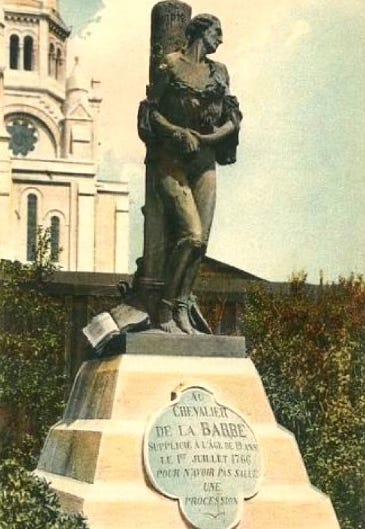
Very near to the Basilica of Sacré-Cœur on Montmartre in Paris stands a statue of the Chevalier François-Jean Lefebvre de la Barre (1745-1766). It depicts him in his last hours, in tattered garments, bound to a stake, and very much in the attitude of a holy martyr dying for his faith. The image is not a perfectly accurate historical portrayal of the events of the day of his death (1 July). He had in fact been cruelly tortured throughout the morning, in an attempt to elicit the names of certain of his friends who might be subject to the same fate as awaited him, but he had refused to divulge any of them. He was not then actually burned alive at the stake; only after he had been decapitated were his remains committed to the flames, with a copy of Voltaire’s Dictionnaire philosophique nailed to his chest. He was only twenty-one, and his crime—such as it was—was that of disrespect for ecclesial dignity, as well as a general proclivity toward the occasional blasphemy. Of course, blasphemy is very much in the ear of the auditor. What the young chevalier was chiefly guilty of were some scandalously candid complaints about the corruptions and petty tyrannies of the Gallican church establishment, culminating in the most egregious display of lese-majesté imaginable: failing to doff his hat at a passing ecclesial procession with a bishop at its head.
The ecclesiastical and state murder of Lefebvre de la Barre was, of course, one of the three famous cases of contemporary religious intolerance against which Voltaire so angrily inveighed, the other two being those of Jean Calas and Pierre-Paul Sirven. All three figured large in his long polemical brief against the established Catholic church in France, but also against the entire history of the Christian persecution and murder of those deemed dissident against orthodoxy and ecclesial privilege—a history easy to illustrate lavishly with instance after instance of barbarity and slaughter in the name of Christ. Popular chronicles of secularization and laicization place Voltaire in the vanguard of the revolutionary movements of the late 18th century in France, and this is as it should be. For this reason, he and all he represents in the public imagination have long been objects of a special sort of malice on the part of culturally conservative critics of the secular age. And yet hereby hangs a paradox. What appalled Voltaire was the cruelty, malevolence, and murderous violence not only of the pious rabble of his time, but of the princes of the church and of the legal mechanisms of its power. What he championed was mercy, pity, tolerance, and an abhorrence of violence. No one of his time and place, however, at least as far as we know, argued against the barbarism of the church and state in the language of Christ’s teachings. There seems no evidence that, at a juncture so late in Christendom’s history, murders in the name of dogmatic orthodoxy and episcopal dignity struck anyone as, at the very least, implausible as expressions of Christianity. And it is hard not to notice that Voltaire, obedient to a conscience obviously shaped by centuries of Christian moral theological usage, was obliged to speak as an enemy of the Christian order. It was only by virtue of his estrangement from ‘Christianity’ that he was able to speak out on behalf of what ought to have been recognizable as Christian moral principles. Clearly, that estrangement was none of his doing; it was the work of the church and of ‘Christian’ culture.
Keep reading with a 7-day free trial
Subscribe to Leaves in the Wind to keep reading this post and get 7 days of free access to the full post archives.