
Roland
Lux Aeterna

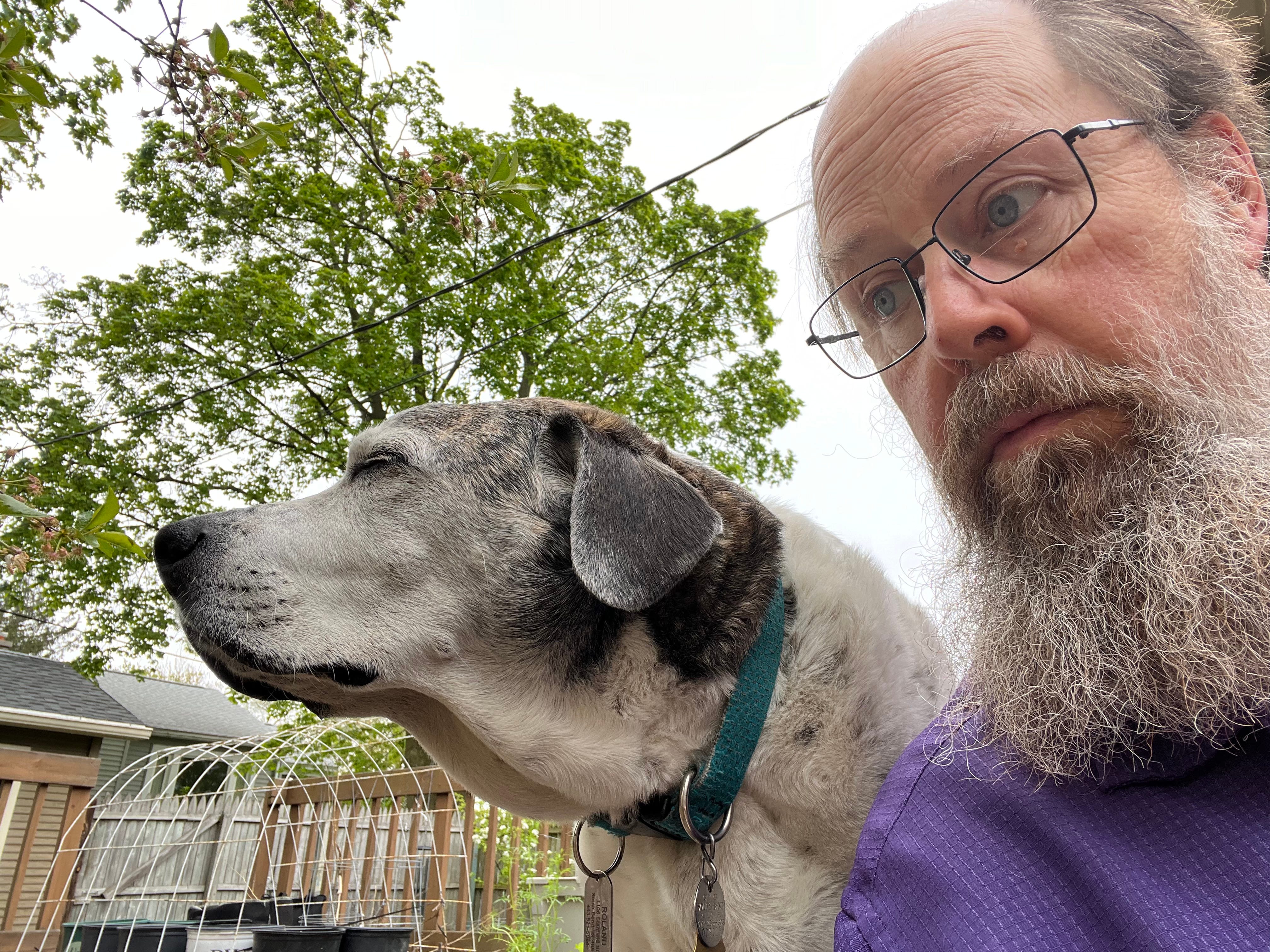
I have a very hard time writing this, but at the moment I am also having a hard time doing nothing.
Roland passed away in the early hours today. We had returned from England. He greeted us ecstatically, we played a bit in the garden, I gave him some of the special treats he likes, he spent the evening with me as I watched baseball, and we went to bed. Then, about half past three, he called out twice in a strange voice and was gone in an instant. He was lying beside my wife when it happened, his happiest place.
The grief is quite unbearable right now, but so many readers ask after Roland with such regularity, I felt I should let it be known. And I thought I should also explain why I may not be posting anything new here for a little while.
Below is the column I had intended to go out today, which I wrote on the flight from London. It has not been edited, and it lacks the final passage I had meant to write, about my joy at getting home to someone in particular.
I love him so very deeply.
*******
A Farewell to the Fens
(or, They are not long, the weeping and the laughter...)
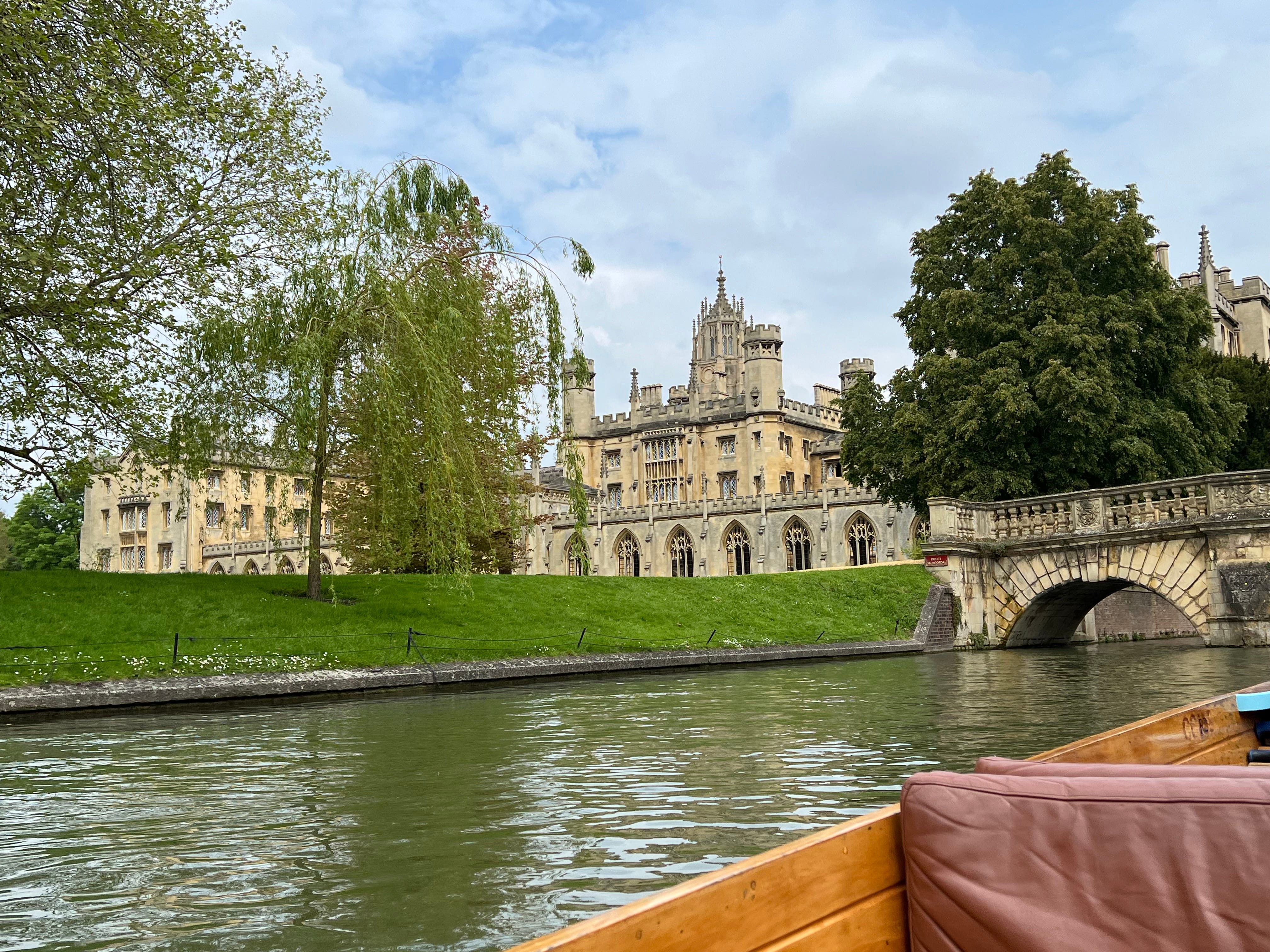
Ne otiemur. I admire anyone who, having taken on a responsibility, insists on prosecuting it faithfully to the end, no matter what obstacles arise in the path. My son and I went out in a punt on the Cam a few days ago. This is different from saying that we went punting, as that might imply that one of us actually stood on the bridge at the rear—in the style Cantabrigian rather than Oxonian—plying the pole and trying to keep his balance; rather, we hired a punt from a tour-agency. We even hired it for a private tour, as there’s actually no pleasure in being crowded into a punt alongside a dozen other passengers; but we didn’t pay the price initially asked. The company claimed on its poster that a private tour would cost £400. When I said that this was too much, the price instantly dropped to £100 (off-hours, you see, or something like that). Even this felt a little exorbitant, but it seemed to me that, having secured a 75% reduction of the fare in roughly six seconds, I was morally obliged to stop there. It was a beautiful spring morning, after all, and this was really the only way we were going to see the college backs at close range while in town; more to the point, I was resolved to give my son the “Cambridge experience” in all its languid glory. So off we glided atop the glassy waves (murkily glassy, of course, but still sufficiently hyaloid to induce a bit of poetical revery in me).
Anyway, as I was saying, I admire anyone who’s scrupulous about doing his or her job of work as diligently as nature and circumstance allow. Such was our tour-guide and poleman D—. He was a young, personable fellow with a pleasant but non-local estuary-English accent. It was his first day out on the Cam on his own, and we were only his second fare ever. I assured him that he need not recite the wonders of the colleges as we passed by their banks, and that the journey itself was all we sought; but, having only just learned his trade, he wasn’t going to prove recreant to his duty on the very first day, and so he forged ahead with the prepared script. He did, however, take pains to speak in a soft, almost purling murmur, obviously wanting to honor both the terms of his employment and our request for a quiet ride. I can confirm that he had memorized all the dates he was supposed to know flawlessly; some of the other details, however—well, let’s just say that the passage of time will no doubt lend polish and refinement to his art. He informed us, for instance, that Erasmus’s tower was named after “a famous Dutch scholar, who was the first man to translate the Bible from Latin into Greek.” As we floated past the Trinity College Library, he told us that it had been designed by a very famous architect who had also designed St Paul’s Cathedral in London, one Sir Christopher Reynolds (Wrenolds?). (Si monumentum requiris demove.) He also did his very best to pronounce the name Srinivasa Ramanujan correctly, and came within just one syllable, one vowel, and one properly placed stress of doing so. In his defense, I should note, much of the text he had been provided by his employers was plainly somewhat lacking as well: “And this is called the Mathematical Bridge. It has that name because its design and construction are very mathematically significant.”
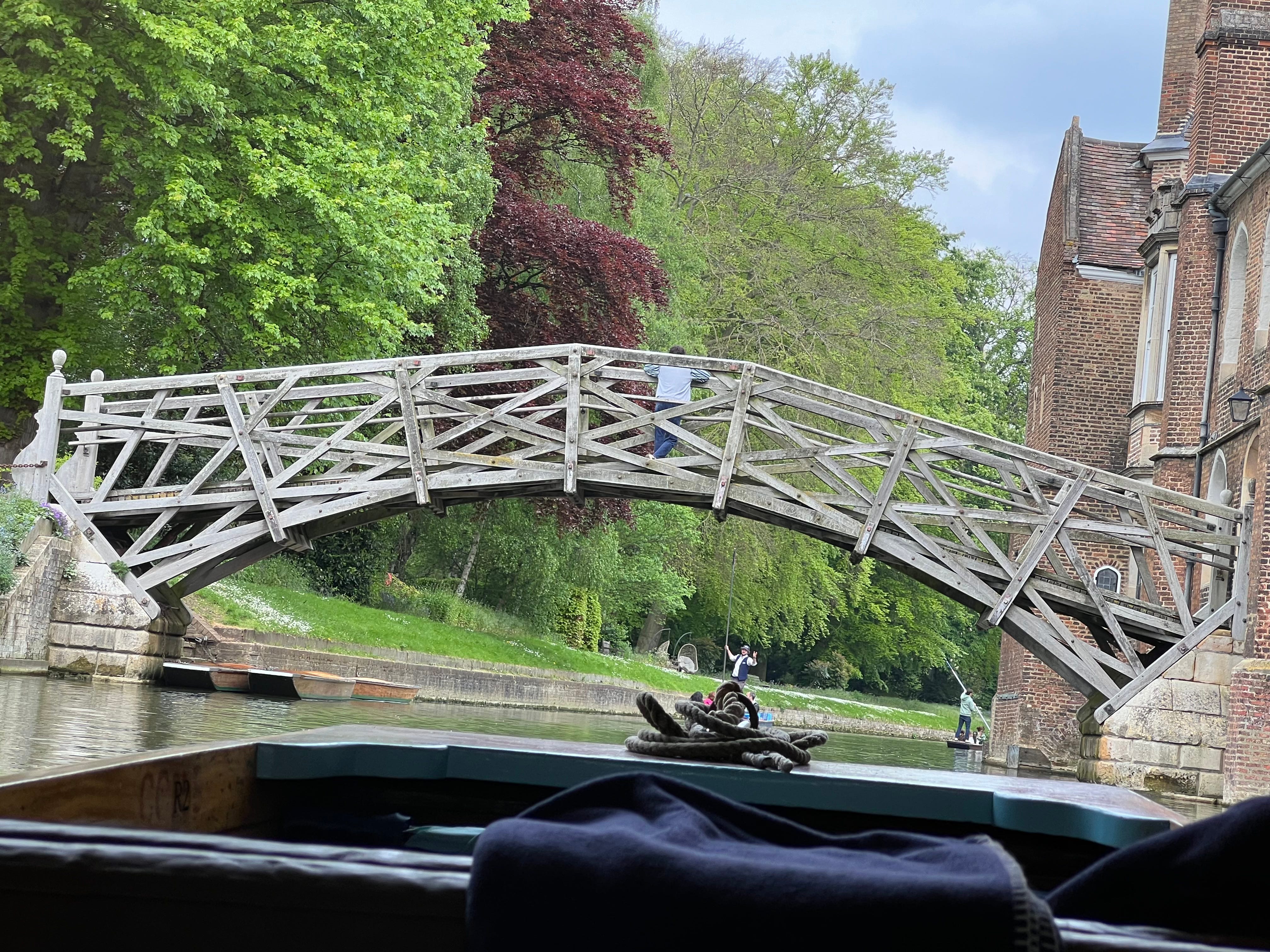
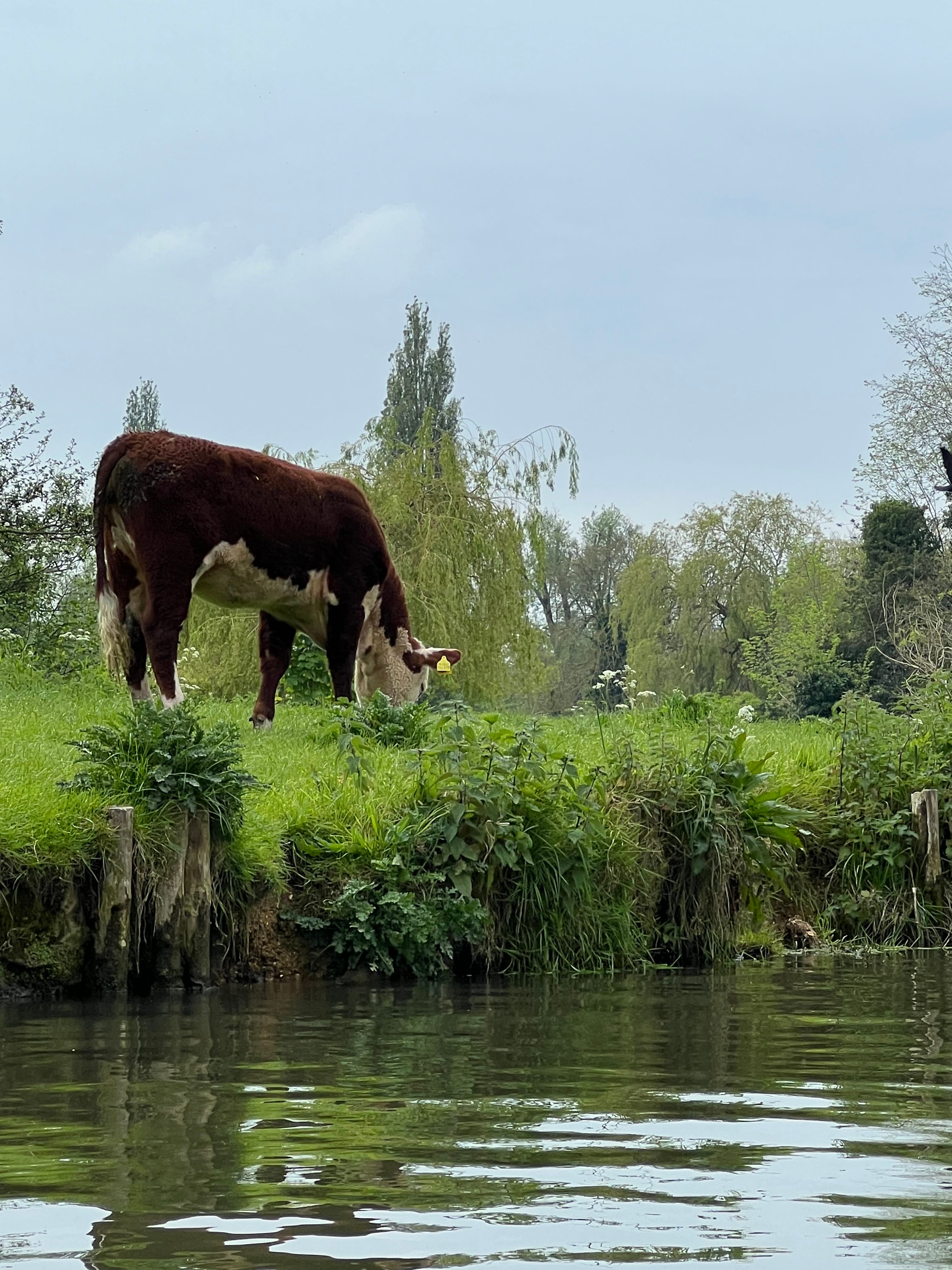
Anyway, it wasn’t at all annoying; it was even a little touchingly silly, and allowed my son and me to trade a few wry smiles along the way. Everything was idyllic—the cool breezes, the mild English sunlight, the gentle lapping of the water against our shallow hull. And one mingles with such elevated and glitteringly gay society along the river’s course: there were some very fine ducks, and a few grandly graceful swans, and one blue heron, as well as some extremely lovely cows contentedly grazing in the riparian pastures or reclining in the shade of willows. When we returned, after nearly an hour, I slipped the young man a £20 note, noticing as I did so that he appeared to be about eighteen years old.
*******
Rus in urbe. Cambridge has grown increasingly urban in the years since my post-graduate tenure. There has been considerable development, residential and commercial, around the circumference of the old town, and the local population has increased enormously. The center holds as best it can, of course, where the colleges cluster together in a kind of miniature conurbation of their own, wrapped in sleepy antiquity; but even there the modern world has made its incursions, turning those old redoubts of privilege into thriving tourist-attractions. Some of the quaint and venerable ways of yore persist, however, and none nobler than the immemorial common rights and usufructs accorded the local cattle; some of them are even honorary fellows of King’s College (though why only honorary I can’t say, given that they’re considerably harder workers than most of the regular fellows). It’s only fair: livestock, bovine and ovine alike, wandered the marshy meadows around the Cam for many centuries before the colleges reared their misshapen granite heads out of the bogs. Cantabrigians, moreover, tend to take a peculiar pride in the city’s free-range kine, and don’t at all resent the gentle beasts for enjoying access to common land from which they themselves are now mostly barred. Many feel (and I share the sentiment) that the local bovine population raises the tone of the place enormously, well above that of such sordidly cow-less precincts as Oxford.
*******
Appensus es in statera, et inventus es minus habens. I should note that there is nothing even remotely Brideshead-ish about my memories of my student days in England. During my years at Cambridge, I was engaged in graduate studies (or postgraduate, as they say in Britain), and so I wasn’t part of the social life of my college—which was Magdalene—in any but a peripheral way. I had not even really chosen my college except more or less inadvertently. The university sent me a list of colleges, asking me to choose my top three; I set Magdalene at the top for no particular reason other than my remembering that the Pepys Library was part of the establishment (C. S. Lewis was also a fellow there for a time, but that didn’t enter into my thinking). I was blissfully unaware when I may that choice that, in those days, it was the last of the colleges still not to admit women. In general, as it happened, it was second only to Peterhouse for reactionary reputation, and with good reason. Many of the undergraduates were very much of the “pelf-and-privilege” species, of the subspecies “hunting-fishing-and-shooting squirearchy.” Imagine, if you will, a small set of young men wearing jodhpurs and their fathers’ haircuts, pipes thrust incongruously into their girlishly smooth jowls, and discussing in exaggeratedly harrumphing voices the braces of pheasants they’d shot that weekend, and you’ll more or less have them sized up. Most of them had been raised for no other purpose than to enjoy the accumulated plunder of all their forebears and to pass it on to all their posterity. During my first year, I had rooms in a building that the college had delayed tearing down only at the last moment when it occurred to someone that the housing office had neglected to provide anything for half the incoming postgraduate scholars. The accommodations were spacious enough—these were not American dormitories, thank God—but the heating was a wretched, moribund valetudinarian wheezing out its faint, prolonged, and tormented death-rattle from narrow vents in the wainscotting, and every room’s floor was at a slant. The downward slope of my sitting-room was sufficiently steep that I frequently felt as if I was going to pitch headfirst into the fire. Two doors over, however, was the building where one of the richest of the young collegians kept his rooms (I withhold his name). The sitting-room alone, which was visible through the ground-floor window, was positively palatial. The fire was large enough for roasting a whole pig, and the dark polished marble of its mantelpiece was a Dionysian riot of scrollwork, volutes, modillions, and foliations, all of it supported upon the heads of two very nubile caryatids (though that may be my own addition to the tableau, memory being deceitful as it is). On the nights when he had friends in for his frequent social gatherings (and this detail is no mirage of recollection), a line of Rolls-Royces sat on the other side of the lane, each with a chauffeur waiting behind the wheel.
In my last year at Magdalene, however, the fellows voted to begin accepting women into the college. The wealthy undergraduates for the most part were aghast and decided they should do something about this; they held a vote of their own and reported the results—preponderantly on the side of continued exclusion—to the fellows, oddly convinced that they had any say in the matter. But indeed, the year after I left, the first female Magdalenians presented themselves to be matriculated and the last bastion of the ancien régime was breached. Curiously, no catastrophe befell the college’s moldering turrets, though perhaps a few of the undergraduates now became vaguely aware that they belonged to a social order already deep in its twilight, with the night fast approaching.
To say there were no women at Magdalen during my time there is not, however, to say that there were not plenty of women to be seen in the company of the young oafs and inbreds who composed the more annoying portion of the undergraduate population. In fact, it was a clear that a certain number of young women were at university principally for the purpose of perhaps one day becoming Mrs Oaf or Mrs Inbred and of thereby being wafted up out of the mires of middle-class existence into the empyrean of... braces of pheasants, I suppose. I remember one occasion when I got to witness one of them in the midst of what was obviously a long and very precisely planned campaign of inveiglement. It was in a college laundry facility located a few lanes down from the college proper, on the other side of the Cam. There, seated in dreamy tranquility and clad in a kind of gentleman’s casual wear that Evelyn Waugh might have thought a little louche, was one of the obscenely wealthy lads of Magdalene, lethargically watching his girlfriend ironing his shirts. She was, despite the homely task she was performing, exquisitely coiffed and attired, wearing (again, I’m not making this up) a short string of pearls, and was discoursing in indignant terms on the scandal of men having to see to their own laundry or any of the other things that “women do better” just because “girls today don’t want to be women,” and proclaiming firmly that she wanted nothing to do with the sort of “so-called women” that one encountered among her female peers at her college. It was all quite absurd and quite practiced. I was fairly sure that the young man had never ever done his laundry for himself, and would have certainly paid someone to press his shirts had she not been pursuing him so avidly; and I was no less sure that she wasn’t actually auditioning for the position of his personal laundress, and that she had her sights set considerably higher. “Don’t overplay your hand, dear,” I thought to myself. “He may look stupid, and no doubt he is, but even the dimmest prey is alert to a hunter who’s insufficiently stealthy.” But what did I know? Something about her, on second appraisal, made me think she was probably a very astute tactician; I suspect now, in retrospect, that she probably never have left any battlefield in defeat. And all of it was, I now also realize, another quaint peek into a vanishing world, one whose sexual and social politics had endured for centuries.
*******
Ad mensam deorum. Part of the “Cambridge experience” I shared with my son was dining at high table one night at Trinity College. We were the guests of David Fergusson and Joshua Heath, and were accompanied by the poet Steven Toussaint. It was all quite ceremonious and for the most part edible. What a grand sight it was, all the old fellows gowned in black and garlanded like the gods (though the garlands, I admit, definitely are my invention). How it carried me back to hear the master uttering the college prayer in a voice as ancient as the earth, its unintelligibly promiscuous syllables drifting down to our end of the table like the ominous, daemonic, disembodied locutions that the Pythia heard issuing from the smoking fissure at Delphi and that only she could interpret. Then we retreated to the combination room for the cheese and port. No more arcane liturgy was ever celebrated in the mystery cults of Graeco-Roman antiquity. The presiding hierophant was the aforementioned Joshua Heath—young, genial, debonair, handsome, a wee bit continental in bearing, and altogether unassuming in the patria potestas grandiosity with which he performed the sacred rites. The cheese—including the great wheel of Stilton from which we each excavated a portion with a great silver spoon—and the drink—principally port, but a tart Riesling and some Madeira as well—twice completed their leftward circuit around the table. My son doesn’t have any pronounced taste for the occult, and neither have I, but I do believe we both came away from the experience feeling somewhat purged in body and soul, and renewed, and certain we had been granted a dim and distant glimpse of a world that lies a little nearer to the eternal forms in their primal radiance than does the ordinary world in whose shadows we typically walk.
*******
Consanguinitas sed non propinquitas. As my wife is English, my son has had little regular contact over the years with the distaff side of his family, so a good part of our time here was taken up quite pleasantly with visits from and assignations with relations—chiefly my wife’s Scottish grandfather and two of her countless sisters—whom my son had had no chance to meet in the flesh until now, and whom I remember only as much younger versions of themselves (which, of course, goes both ways). Our sense of time is such an odd thing. On the one hand, I realize and can even sense how long it’s been; but, in settings that are so familiar to me from all those years ago, those encounters make it feel as if I had closed my eyes for only a moment and then opened them to find that the better part of my life had instantly passed by. Then again, I have the same feeling every time I accidentally catch sight of myself in a mirror.
Enters literature and eternity an uncommonly bright and noble dog. Our deepest condolences and it was our honor that the two of you shared some of your times together with all of us.
Dearest Dr. Hart, please accept my deepest condolences. I know that it is a small solace, but at least, like Odysseus’s dog, he waited until his friend returned home. There should be no doubt that one day you will be eternally reunited in the Kingdom, where he will finally make his peace with the squirrels.